Jade 玉
The Origins of Jade in Asia
In China, the term jade (yù 玉) is commonly used to refer to two different materials: jadeite and nephrite. Both are minerals admired for their hardness, color, and the luster produced when polished. Jade can be found in a variety of colors, with varying degrees of translucency. It is a difficult material to carve, even with modern tools. Therefore, carvings are prized not only for the quality of the jade, but also for the quality of their craftsmanship.
Since the Hongshan culture (c. 4700-2900 BC), Jade has been used to make ornaments, tools, weapons, and ceremonial and burial objects. Historically, much of the jade in China was sourced from the region of Khotan in western China, known for a creamy white—or “mutton fat”—nephrite. Since the 1800s, Burma has been an important source for jadeite, particularly a highly sought after emerald green color.
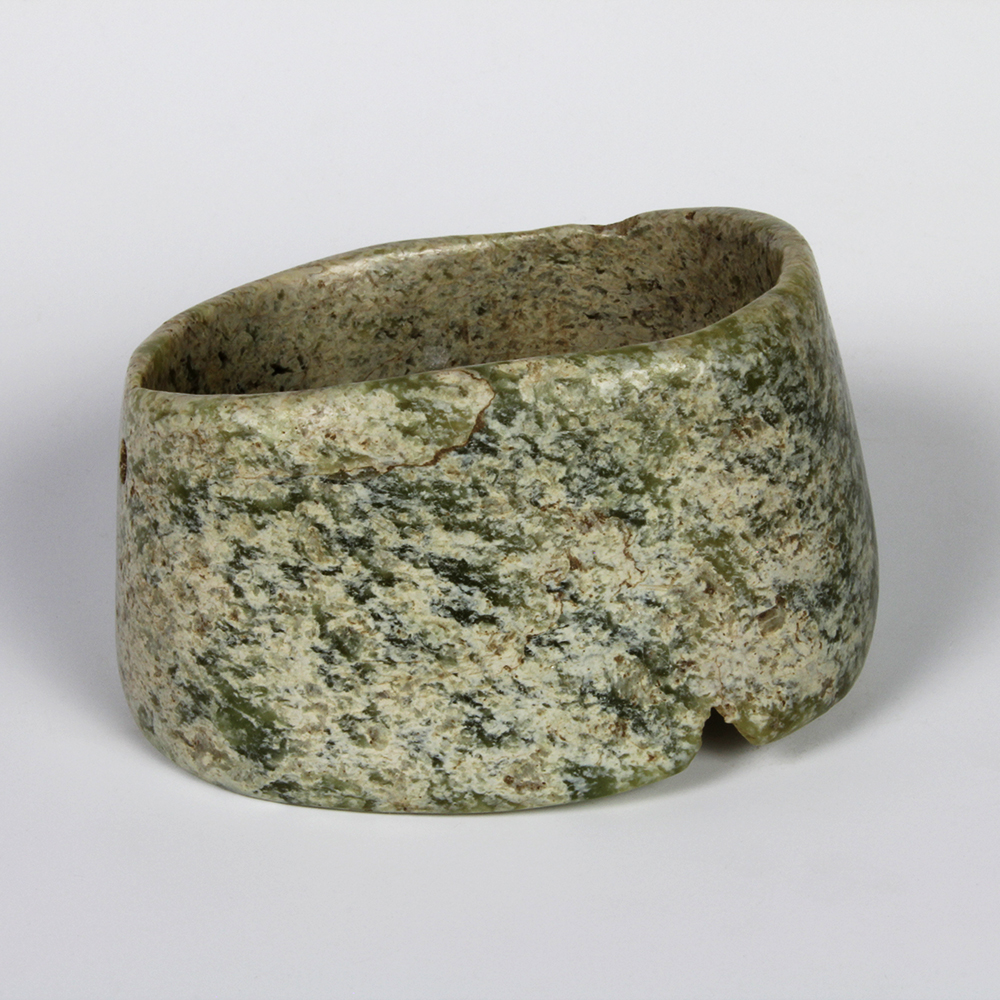
Hoof-Shaped Ornament, 馬蹄形器, jade 玉, 7.9 x 6.3 x 4.4cm, Neolithic period 新石器時代 (8500 - 1000 BC), China 中國. Cat#14017.
Jades of this shape are often found at the head of the deceased, leading us to believe that they were used as a hair ornament.
The Importance of Jade
Jade is revered in China more than gold or silver. It is believed to have powers of protection, longevity, healing, and luck. It is also believed to link the physical and spiritual worlds: Early noblemen wore jade pendants and ornaments on their clothing as symbols of status, and they were later buried with them. Jade objects were also placed on and around the deceased. Some objects were even fashioned to plug the orifices of the body—talismans of sorts to preserve and protect the deceased into the afterlife. Jade was so cherished as a mortuary material that during the Han dynasty (206 BC–220 AD), artisans crafted full body suits from small pieces of the stone, which they stitched together with gold thread. By the Qing dynasty, the emerald green jade imported from Burma was favored and worn by wealthy individuals.
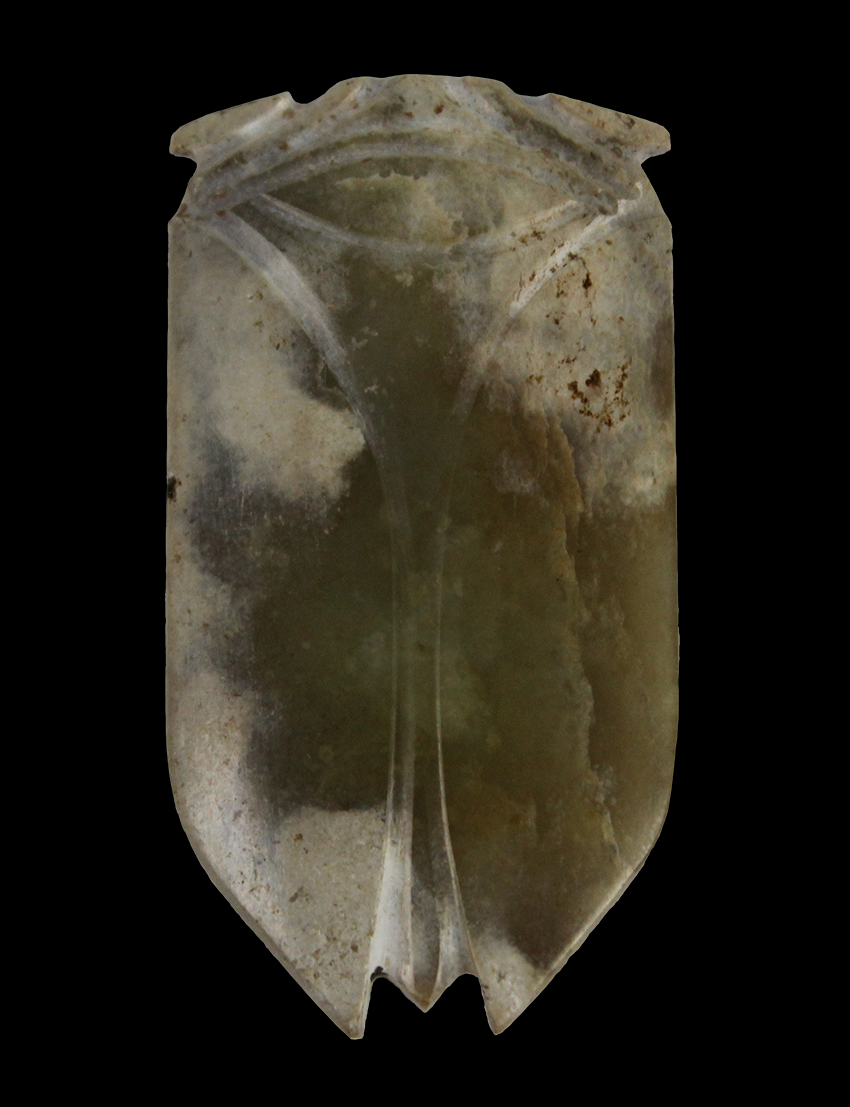
Cicada 琀蟬, jade 玉, 6.3cm, Han dynasty 漢 (206 BC–220 AD), China 中國. Cat#140181.
Cicada shaped jade amulets were placed in the mouth of the deceased during the Han dynasty. Because the cicada burrows into the ground for up to seventeen years before emerging from the earth for its final form, it is believed these amulets were used to guide the spirit into the afterlife.
Warring States Jade
The era of the Warring States (476–221 BC) was a time of great change in the utilization of jade in China. Jade went from being plainly carved to having elaborate, imaginative designs. It changed from primarily serving as tomb goods to being accessories for noblemen, in the form of plaques, belt hooks, hair ornaments, jewelry and most importantly—sword fittings. Advancement in drilling technology enabled the jade carver to express themselves artistically. Warring States jade comes in many colors, including beige, brown, olive, celadon and ivory, but it is always nephrite. Popular designs focused on animals, real and mythical, dragons, tigers and birds were especially favored.
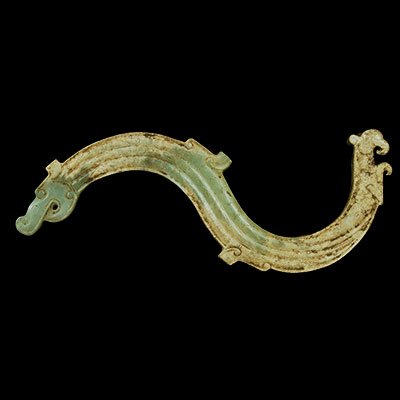
Dragon Form Pendant, jade 玉, 10cm, Warring States Period 战国 (476–221 BC), China 中國. Cat#140137.
The mythical Chinese dragon is believed to be a god of water and has been made into carvings from jade for thousands of years, since as early as the Hongshan culture (c. 4700-2900 BC).